The CLAMP TRPG Project
CLAMP TRPG Gameplay
This game can be played solo or with any number of players. First, determine the first player to play with “Rock, Paper, Scissors” and go in a consistent order, either clockwise or counterclockwise. It will also help to select a mediator; to make decisions on rules, and an archiver; to record what is happening during gameplay.
First, establish "what their character wants to do" and "what situation they want to be involved in." and establish reasonable boundaries for the session. This is the initial setting of your character, meaning they start their game from a stated location and doing a stated activity.
This is what a player’s turn looks like as a flow chart:
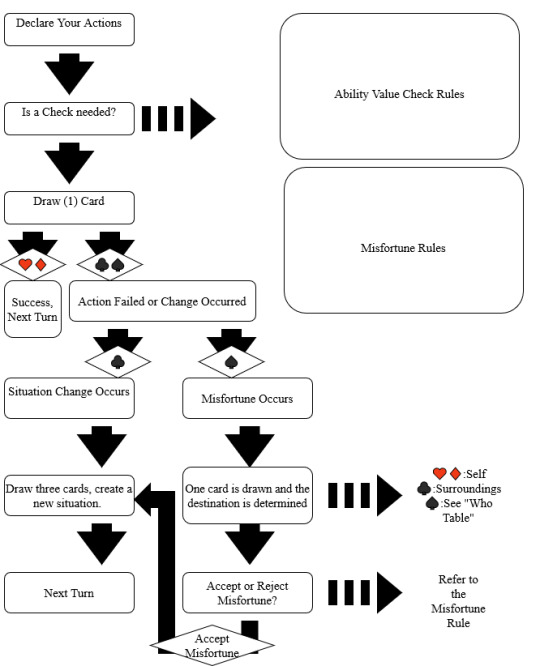
What is a Check and How to Use Them
Checks are decided by group majority, as a game wouldn't be fun if you had a Check for each mundane activity such as walking or breathing. Checks are meant to see if your ability is high enough for the task your character is going to do, but only if it seems unreasonable to the group.1. Compare the "difficulty level" of the task that the group selected and the "ability value" of the chosen character, and compare them to the table (Note: The table to be compared is different depending on the Check Difficulty.)
2. Determine the "Reference Value".
3. Draw a card at random from the deck of cards, and compare the number shown on the card with the “Reference Value”. In this case, "A" indicates "1," and "J," "Q," and "K" indicate "11," "12," and "13," respectively.
4. If the number on the card is equal to or smaller than the check threshold, the action is successful.
5. If the number on the card is higher than the check threshold, the action fails.
6. If a joker is drawn, another card is drawn, and if the color of the suit is "red", the action is a success, and if the color is "black", the action is a failure.
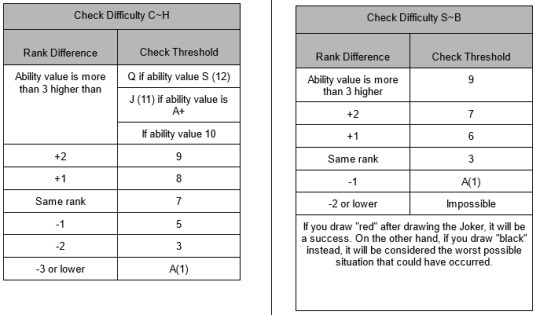
For Example, Character wishes to pick a lock on a door, [Character Rank: Professional, Ability Values: Int:B (9) Str:E (6) Luck: G(4), Special Ability: Lock-picking] and the group determined that the lock isn't that difficult but someone without some skill would face difficulty. so the decided Check Difficulty for this particular is D.
Since lock-picking in this character's case was a learned ability based on their background, the Ability Value checked would be Intelligence. Since the Ability Value is +2 above the Check Difficulty, we would need to draw a card that is equal to or less than 9 to pass the check. If the number drawn is higher than the threshold, the check failed.
If a Joker is drawn, the next card drawn determines whether its a instant success or an instant failure. If you draw "red", it will be a success. On the other hand, if you draw "black", it will be considered the worst possible situation that could have occurred.
Destiny Draw
After you have declared a character action and after deciding whether a check is needed, draw a card. This card will determine the outcome of the desired action. If a red card (Hearts or Diamonds) the action is allowed to happen unchanged. If a black card (Clubs or Spades) the action is changed. If its a Spade, its an unfortunate change.
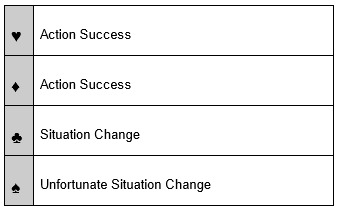
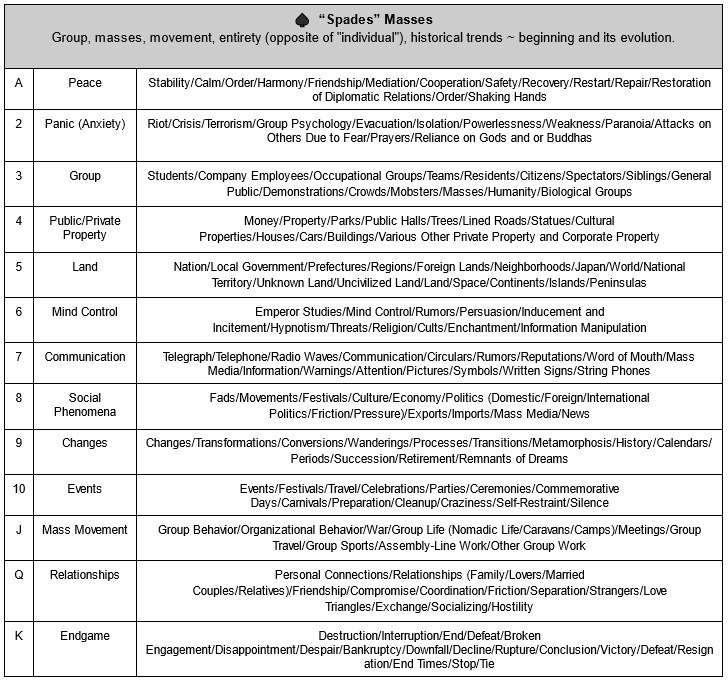
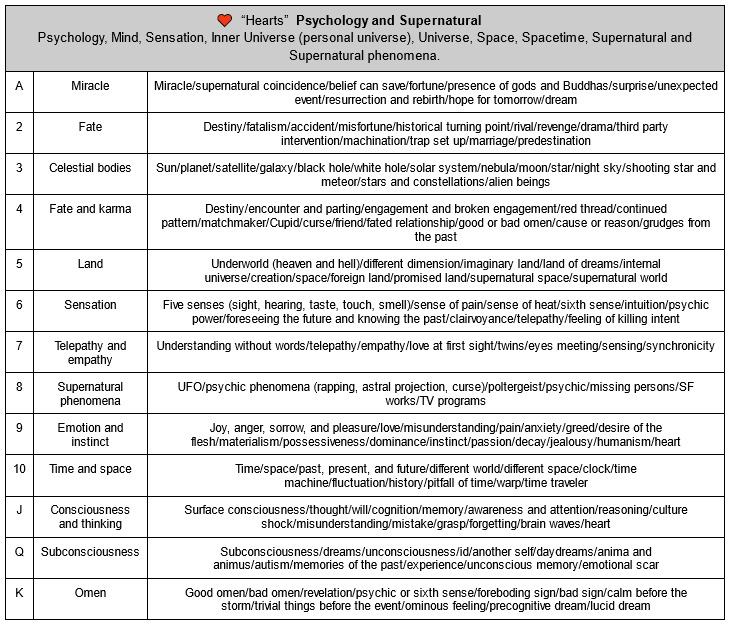
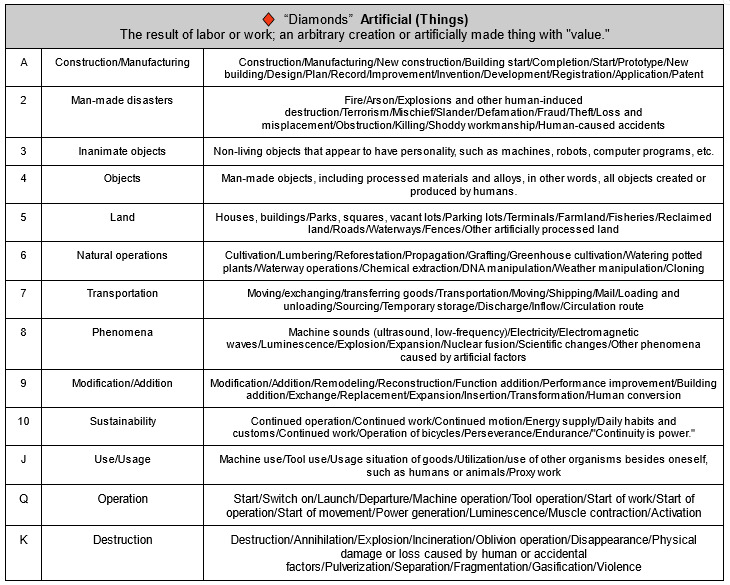
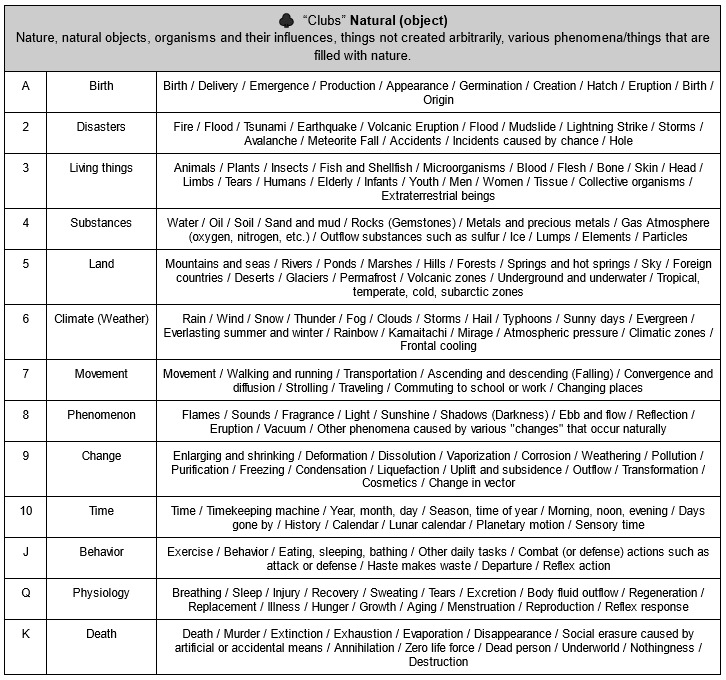
Changes are determined by drawing 3 cards and creating a scenario using the keywords from the selected cards, referencing the charts below. These changed scenarios will happen in place of the declared action. If you encounter a Joker, keep drawing 3 cards until no Jokers appear.
For Example, I decided on an action to go to the library (no checks were needed), I drew a Club. The 3 cards that I drew to decide the change was A of Hearts, 9 of Hearts, and King of Spades. Those terms could be interpreted as Surprise, Emotions, and Disappointment. The scenario could be "While trying to go to the library; I got surprised by some dark figure. It scared me a lot so I ran away, but it was just the statue at the front of the library so I felt disappointed and embarrassed."
This is the part of the game that requires improv, as these randomly decided scenarios can be serious, or absolutely silly.
Dealing with Misfortune or How to Change Destiny
Misfortune is inevitable in some cases, but we still need to determine a few things before an unlucky event happens. Primarily, who the Misfortune will affect:
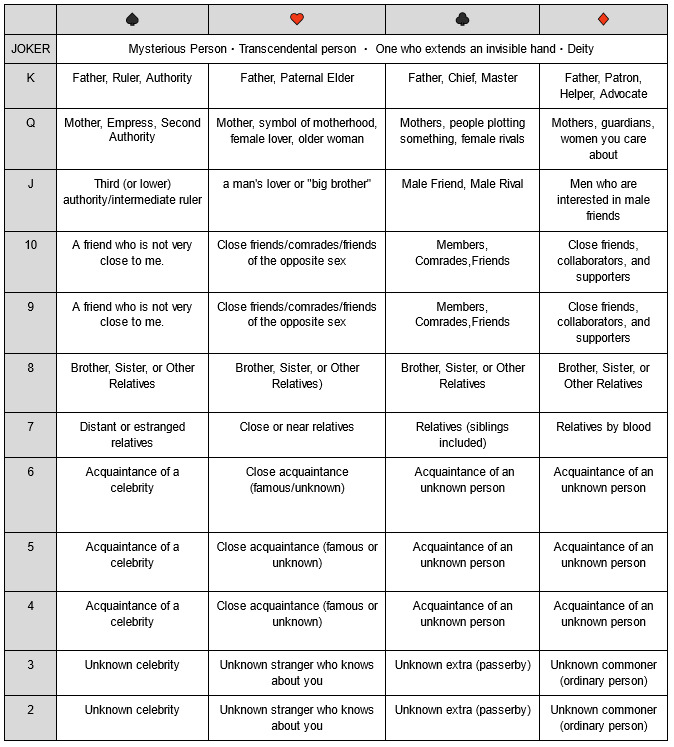
If your character wants to change Destiny (Hell, which respectable CLAMP character wouldn’t want to change Destiny… or at attempt it), they can reject Misfortune one of two ways:
Redraw Points: Deduct one (1) Redraw Point per turn to Redraw the Destiny Draw, but it can only be done once per character turn. Once your Redraw Points are 0, you’ll have to wait until next session for them to be restored.
~OR~
Bounce-back: Draw a card and compare the number on the card to the Ability Value Luck. if the drawn card is equal or less than the Ability Value, you have bounced back the misfortune and your character is unaffected. If the drawn card is greater than your Ability Value, you will be affected by the misfortune. If a Joker is drawn, draw one more card: If the suit is red, success and if the suit is black, unsuccessful. Bounce-back can only be attempted once per Misfortune. Whether or not the player receives the misfortune, he or she must draw three new cards and perform the "Situation Change" 3 card draw.
we decide Who will be affected by misfortune, we have until the end of the player turn to declare whether we want to use Redraw Points or Bounce-back to reject the Misfortune.
Misfortune Points
In Destiny Draw if you draw a Spade card, you acquire one (1) Misfortune Point on your Character Sheet. These Misfortune points can add up because even one point can affect a player. If you have more than 9 Misfortune Points, you cannot bounce-back Misfortune. If a Misfortune is Bounced back by a player, the misfortune will happen to the player with the highest Misfortune Points and the player will receive a Misfortune Point. Successful Bouncebacks do not gain Misfortune Points.
Fortune Points
Fortune points can only be granted to players who have accumulated Misfortune Points. If you have more than 14 Misfortune Points, you must convert them to Fortune Points immediately upon accumulation.
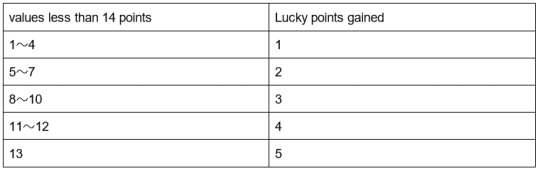
Fortune Points can be used at any time during play through one of two ways:
1. Spend 1 point to automatically succeed in any check.
2. Spend 1 point to manipulate the scenario as you see fit.
Collective Actions
Whenever two players are in the same location, Collective Action can be declared (or not declared). This allows for players to discuss their actions and to decide the order for the chosen actions. This could be seen as these characters “taking their turns” all at the same time, or in a sequence as it's up to the group to decide. Ensure that everyone gets to speak freely. The individual actions still are subject to the Destiny Draw outcomes, though.
If a character leaves the location of the other players or any changes happen, the Collective Action automatically ends. The next player continues normal play.
Creating a Story
Games must have excitement and this game should be exciting for people to be interested. Misfortunes can be terrible, but also create a captivating story. Players are encouraged to make their characters’ performance dramatic, as it will naturally create interesting stories.
Ensure that everyone is involved in the game, as this creates excitement! Avoid situations where only one player experiences exciting scenarios or one player can’t experience exciting scenarios. This game is a group activity, be sure to leave nobody out of the fun!
Ending the Game
Your characters will be changed by the story’s progress, some changes might affect the next sessions. For Example, a Character sprained her leg or the character's personality has changed. These changes are to be recorded on the Character sheet and could affect other play sessions.
Once game play has gotten to a stopping point, discuss the game. Check up on any problems or questions that you had about the session. Declaring a definite end to a game allows players to know the game’s story has ended, as most games don’t get played forever.
Recording Sessions
The archiver has the most important job as they record the story as its unfolding. This will serve as a memory to lock back on or to see new aspects of the game you didn't notice during play. Recording is vital as a narrative device too, as that’s how Clamp School Paranormal Investigators started out as.
To Be Continued…
You made a good captivating story that people want to continue. Congratulations! It’s encouraged to continue playing with the same character as the previous session so that personality traits can be developed.
This is the end of the quick start guide, I hopefully covered most of the game-play to at least give people some sort of idea what this game even is. Again, this is a very early prototype of a translation.